#78: I am the first white guy to ever go to Japan
Death by Consumption
10/28/25 - 11/18/25
I have returned! Welcome to Japan Week on Death By Consumption. We actually returned last week, so I fear the trip is already fading into a lovely dream I once had, now that I'm back to real life, and have logged back into the terrorist organization known as Microsoft Teams. (And a warning: this will be a long one, so I would suggest clicking the headline above to open it in full, because it will almost certainly get cut off as an email.)
This will not be a travel blog, nor is it a list of recommendations for your own trip to Japan (this will probably be the only Japan "guide" in which the only recommendation for the entire city of Kyoto is for a really good bathroom). This is simply an extremely non-exhaustive accounting of some notable consumption experiences we had over there, on what was, ultimately, one of the best vacations of my damn life!!! If I gave you the full recap of our trip, this email would run into the hundreds of thousands of words, so you'll just be getting some highlights that are (hopefully) fun. If nothing else, this will give you something to read on the toilet while you're hiding out from your family after Thanksgiving.
The first time I visited Japan was in 2007, when I was 20 years old. Back then, I had been saving money to go to Europe with my girlfriend, and when we broke up (no idea why!!!) I went off to Japan instead, backpacking solo for nearly a month. It was the first major adult trip of my life (I say "adult" even though I did, in a hostel in Kyoto, wake up from a nightmare literally screaming, "Mommy!" in a dorm I was sharing with 15 other people....... I hadn't said "Mommy" in at least a decade, but my subconscious decided that was the moment for it to come roaring back into my vocabulary).
The first time I had ever traveled solo, that trip was a massive experience for me that shaped the rest of my life — I will never forget waking up that first morning in my hostel in Tokyo, on the 50th floor of some enormous building, looking out in awe at the city stretching out below me as far as I could see, a moment that absolutely shattered my little Wisconsin brain. I will also never forget the feeling of being so far away from everyone and everything I knew for the first time, that unique mix of freedom and loneliness that I eventually grew to find so familiar, and even comforting.
This is all to say: yes, I know it's the most cliche thing in the world, a white guy loving Japan, but the country left such an indelible mark on me that it left me no choice. So, forgive my descent into white-guy cliche here, but there was really no helping it. Enough prologue — let's get into it!
A manhattan — at Grandfather's, in Shibuya, Tokyo
Tucked down in a basement off a busy street in Shibuya, this dark and smoky bar — so choked with cigarette smoke our eyes were streaming tears the whole time — offers decent cocktails and even better music. The DJ is, I assume, the titular Grandfather, an old man hunched behind the bar, meticulous in his button-down and tie, who smokes cigarettes, occasionally mixes a cocktail, and spins tracks from his impressive vinyl collection all night. It's been open for at least 40 years, which makes me wonder if it was always named Grandfather's, even when the guy was young. In the 80s, was it just called "Father's"? I have questions.
The drinks are, to be honest, quite average, but they're cheap, just a couple bucks, and served in cute glasses, and frighteningly strong, so I ended up getting drunk on three Manhattans while watching Grandfather pluck vinyl out of his enormous collection of albums. Vinyl bars are, of course, a huge thing in Japan, and the music at Grandfather's feels more basic, more mainstream than many of the other spots, which is great when you just want a good sound system but also the ability to have conversation. At Grandfather's, there's none of the strict silence you'll find in other listening bars — you're there for the music, yes, but you're also there to have a good time, so you're free to chat.
While we sipped our outrageously strong, tiny cocktails, Grandfather bounced from album to album, serving up crowdpleasing classics like Jackson Browne, Steely Dan, and Fleetwood Mac. But then I noticed a glint in his eye as he pulled a new record off the shelves behind him. “Grandfather is about to do something crazy,” I told Justin, but nobody was prepared for what he hit us with, as Adam Levine’s voice — singing those unfortunately iconic opening lyrics: "I was so high I did not recognize..." — came blaring through the speakers. Yes, the man had selected Maroon 5 on vinyl, casually dropped into his hour of 1970s hits. It was an absolutely diabolical choice, one that would get most people's aux cord privileges permanently revoked, and yet in that context, I have to say it was the most I’ve ever enjoyed Maroon 5.

Some sort of whisky cocktail — at Bar Nayuta, in Osaka
Bar Nayuta is, like Grandfather's, a "hidden bar" that every tourist already knows about. It is one of the trickiest bars to find — there's no sign, it's on a third or fourth floor of a nondescript building, and the door is only waist-high so you have to practically crawl in. The bar itself only seats about 8 people, with extra space along the wall for people to drink and sit while waiting for one of the precious bar seats. On the night we arrived, the room was packed with not only exclusively white people, but the worst kind of white people: heterosexual couples. Our hearts sank, but we figured it had taken so long to find the spot, we had to at least try a drink.
The bar is one of those spots that has no menu, but you describe what you like and they make something for you, which, honestly, usually annoys me. It always feels like forced whimsy — just tell me what cocktails you make best, and I'll order one of them! — and, frankly, the speakeasy-style entrance was already giving forced whimsy, so my skepticism was growing by the second. I asked for some sort of a boozy, slightly sour whisky cocktail, and the mystery drink that arrived turned out to be absolutely delicious. Okay, fine, I thought, sipping my custom cocktail, these straight people might be onto something.
Around us, all the couples were meeting other couples, everyone swapping stories and recommendations from the Japan Tourist Holy Trinity of Tokyo, Kyoto, and Osaka. I felt like I was on a cruise ship for Millennials. The small talk was maddening to eavesdrop on, and even worse when we got dragged into a mind-numblingly boring conversation with the couple next to us (Canadian, very nice people, let's hope they aren't reading this), who could not believe it when a couple they had met at a bar in Kyoto walked into this bar.
"What are the chances that we see them twice in Japan?!" the woman asked me. Well, Mary, honestly the chances are pretty high, considering you're all going to the same three cities and following the same TikTok recommendations! I sipped my drink to keep my mouth shut.
But all my attention for the night was focused on the guy to the other side of me, a miserably arrogant straight guy with a silent wife, who ordered drinks by barking demands at the staff of the exact flavors he expected from his drink. With precious seating space in this tiny bar, this man had put his bag on the end of the bench I was on, taking up an extremely valuable spot, forcing four of us to squeeze into space meant for three. Which meant I decided to take matters into my own hands, and to initiate a passive-aggressive war for territorial control of the bench. With my thigh, I slowly shoved his bag closer and closer to falling off the edge, while he used his elbow to shove it back into my personal space. We both carried on like this for half an hour, pushing the bag into each other while never once acknowledging we were at war. With each passing second, I hated him more and more.
When he and his wife finally decided to close their tab, the man erupted with a loud and righteous indignity. "You don't take DISCOVER?!" he practically shouted at the waiter, and I had no choice but to let all my inner antipathy out, and to laugh openly and obviously at his expense. You mean to tell me this guy was behaving with Amex Black Card attitude all night, only to whip out a Discover card? He was enraged, incensed, could not believe it, was practically trembling with fury at the disrespect towards him, a certified Discover Card Member. The indignity! Not for the first time, I had the thought that we've really, as a society, lost all sense of shame.
Karaoke and an ice cream sundae — at Sweets & Bar White Bunny, in Osaka
In many Japanese cities, but especially Osaka, some of the best restaurants and bars are hidden on the 3rd or 4th floor of a nondescript building that looks like your optometrist's office. There's virtually no way of knowing what you're in for until you open the door and walk in. When we met up with our friends Emily and Jules in Osaka, who were in Japan on their honeymoon, we essentially all ended up spending the entire three days together picking doors almost at random, opening them, and eating and drinking in whatever setting we found inside.
This led to some unbelievably fun experiences — one of my favorites being the empty, tiny gay bar we found on the 2nd floor down some random hallway, in which Emily and Jules grilled the bartender about lesbian life in Japan through Google Translate, before he finally typed into his phone, "I may not be the most informed about lesbians in Tokyo." Fair!
We had some incredible dinners in these tiny random spots, all of which were single-man operations, cooking spectacular dishes in spaces the size of my apartment's bathroom. And here I'm going to give you the most important tip you could ever receive about Japan, and the only way to guarantee you never have a bad meal: use the website Tabelog, Japan's Yelp. I fear I may be betraying some confidences here, as the Japanese people we met were reticent to even talk to Westerners about Tabelog, reacting in horror when they learned we were already using it ("How did you hear about that?!" I was asked, in the same tone you'd ask someone how they heard a piece of gossip you only told trusted friends). With good reason, too — we were told many stories about a beloved local spot that blew up on Western TikTok or Instagram, and immediately became a place only for tourists. (The locals are pissed to lose one of their favorite restaurants, but, as someone told us, the restaurant owners are almost always very happy to be "discovered.")
Japanese people are very tough on their restaurants (I would be too, if I had this much incredible food in one country!), so anything that ranks above a 3.5 out of 5 stars on Tabelog is guaranteed to be spectacular. And if it's above a 4? Forget about even going there, you should have gotten a reservation 6 months ago. In 2+ weeks of eating in Japan, Justin and I became total Tabelog snobs, turning our noses up at a mere 3.25, and willing to wait over an hour if it meant getting into a 3.75. So, look, I'm giving you the key to always finding impeccable food in Japan, and all I'm asking is you don't abuse it and ruin every restaurant for Japanese people, okay?
But there's no Tabelog for bars, so Emily, Jules, Justin, and I were left to fend for ourselves, drinking at as many tiny, unsuspecting bars down nondescript hallways as we could find. Which led us, one night, to Sweets & Bar White Bunny, a second-floor bar that randomly serves enormously decadent sundaes and parfaits. We ordered a round of drinks and ice cream, but before we could even dive into the sundaes we were interrupted by the sounds of a man belting a Japanese ballad into a karaoke mic.
When we arrived at the bar, there were only two other people there — a kid in his 20s, silently drinking and playing on his phone, and a middle-aged man, who barely even looked up when we walked in. But, for whatever reason, a switch flipped with him about 10 minutes after our arrival, and he decided he simply had to serenade us. As we cheered him on, he stood over us, singing his goddamned heart out to whatever Japanese classic he had selected, and when he was finished, we immediately threw our own song selections into the mix. It was on.
For at least the next hour, the four of us sang karaoke with this man, who tried his best to keep up with most of our English-language selections. Emily asked ChatGPT what English-language karaoke songs were most popular in Japan, and we relied on the list it gave us, with middling success (another victory over the machines for human brains!). But the true cross-cultural megahit — which, really, should come as no surprise — was John Denver's "Take Me Home, Country Roads," which absolutely brought the house down. Even the young female bartender knew every damn word to that song. So if you ever find yourself trying to forge a cross-cultural connection via karaoke in Japan, that song is a sure ticket.
Throughout all this madness, the 20-something kid sitting at the bar continued drinking silently, barely even acknowledging the rowdy karaoke session going on just over his shoulder. Until, out of nowhere, he stood up, grabbed the microphone, and unleashed a staggering rendition of Aerosmith's "I Don't Want to Miss a Thing," belting into the mic, hitting practically every note, as we screamed and whooped with encouragement.
Karaoke excellence achieved, the young man sat down at the bar and never once touched the mic again for the rest of the night. Like a true star, he knew when to leave us wanting more.
12 gyoza and NO MORE — at Gyoza Daigaku, in Kobe
Justin and I took a day trip to Kobe, where we went to this (highly Tabelog-rated, of course) restaurant in Kobe's Chinatown, where the one and only thing on the menu is gyoza. The only question, really, is: how many do you want? You could choose either 12 or 18 as part of a lunch set meal that came with rice and soup, or if you only wanted gyoza you could get an order of 7 or 14. We chose the 12-gyoza lunch set each, and when it arrived we could not believe what we were eating. Without question, these were the best gyoza we had on the entire trip, and we talked about them practically every day afterward. The filling was light but packed with flavor, the dipping sauce was a complex mix of tangy, spicy, salty, and umami, and the wrapper was tissue-paper thin. We wolfed them down, which only made us hungrier for more, so I pulled out trusty Google Translate and used it to ask the waitress, "Can we please get 14 more gyoza?"
"NO," she replied. "One order only." It turns out this restaurant has a strict one-order-per-person rule, presumably to keep turnover high, even on a slow day like when we visited, where half the seats were empty. We were not allowed to get even a single extra gyoza, no matter how much we begged. We were shattered, heartbroken, devastated, and left feeling like we had made the gravest mistake of our lives when we ordered 12 instead of 18. I still haven't recovered, nor do I think I ever will. Let this be a lesson to us all. When life gives you gyoza, ask for the most you possibly can.
A bottle of sake — Izakaya Shinsui, in Kurashiki
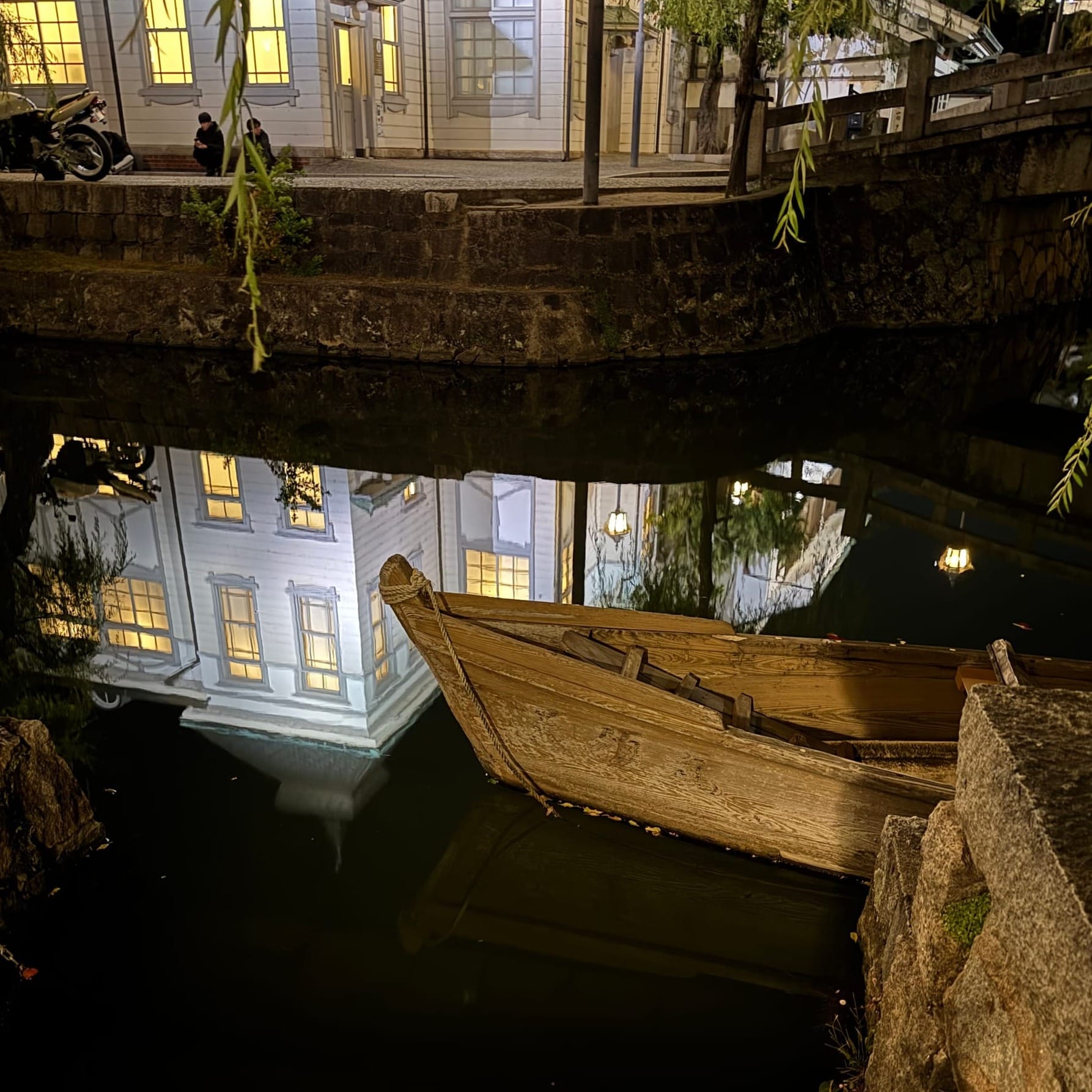
We spent one night in the town of Kurashiki, famous for its absurdly picturesque canals that are surrounded by historic wooden buildings, little bridges, and drooping willow trees. The town tends to be more of a day trip destination, which meant after sunset the old town completely emptied out, leaving us virtually alone to explore the narrow wooden streets. Through — what else? — the magic of Tabelog, we found our way to this little izakaya, nestled at the bottom of a steep hill, in the shadow of a gorgeous temple that overlooked the town.
Sliding the door open, we were huffily greeted by an older woman, who clearly did not want to deal with Americans right now. Despite Japan's famous hospitality, this was a fairly regular experience for us — someone at a bar or restaurant practically rolling their eyes when we walked in, like, "Oh, great, now I have to figure out how to communicate with idiots." But we never let it put us off from a place, and actually viewed it as a challenge, an invitation to try to break down their walls, to charm the shit out of them, and to ensure we became friends by the end of the meal.
This izakaya is run — like many of the best are — by an old, hunched man working furiously behind the bar, and unlike the waitress, he was thrilled to have us in his restaurant, eager to speak with us despite the three of us having, like, 10 total words in common. Tragically there were no free seats at the bar, so we were shoved in a table in the back corner of the place, far from the old man and all the action. But we immediately got to work, ordering a collection of dishes from the menu, pointing at things and just going with it, and I felt the waitress begin to let her guard down, once she realized we wouldn't be asking her a zillion questions she doesn't understand, or making her job even harder. See? I wanted to say. We're winning you over already. Please don't hate us! This is how I know I'm still a Midwesterner at heart.
The rest of the izakaya filled up with exclusively locals, and our table was suddenly surrounded by groups of men, all loudly talking and ordering plate after plate of food and drink after drink. To one side, a table of four middle-aged men were aggressively throwing back drinks, ordering various bottles and generally mixing alcohol in a way that would guarantee a hangover if you weren't a seasoned professional (which these guys clearly were). One bottle in particular caught my eye, and I wanted to know what it was.
Now, an aside on something weird that happened to me on this trip: 20+ years ago, my freshman year of college, I took a single semester of Japanese, curious to see if I could learn the language. I enjoyed the class immensely, but ultimately didn't continue because the only Japanese classes available were at, like, 8 am on Mondays, and I wasn't about to wake up that early every week (I love letting laziness hold me back in life!!!). I assumed I had lost the language since then, and yet the longer we stayed in Japan, the more Japanese kept coming back to me. At first it was basic stuff, like remembering "sumimasen" means "excuse me." Then it got more complicated: I realized I could count to 10, and then 100, and then past that (okay, this isn't that special; if you know 1-10 in Japanese, you can basically figure out the rest). By the end, I was starting to construct actual (basic) sentences. I can't tell you anything I learned in my four years of college in the vast majority of my classes — I went up to the 300 level of chemistry and yet I'm still not really sure what a molecule is — but that Japanese 101 somehow lodged itself permanently in my brain.
So when the men next to us ordered a delicious-looking bottle of something, I leaned over and asked: すみません、それはなんですか ("Excuse me, what is that?"). When they replied in Japanese ("This? It's sake" [with a lightly implied: "Are you a fucking idiot?"]), I felt like I could have walked outside and lifted a full car over my head. I had organically communicated in Japanese! Sure, I was speaking at the level of, say, an 18-month Japanese baby, but I had done it! All by myself! I thanked them, and we immediately ordered the same bottle from the waitress, who I saw in that moment decide that maybe she did like us after all. When the same bottle arrived at our table, the guys next to us burst into laughter, and raised their glasses towards us.
This little izakaya, in addition to serving some truly fantastic food, turned out to be one of my favorite meals of the trip. After the madness of Tokyo and Osaka, which, as we approached peak leaf season, were getting busier and more tourist-choked by the day, we had found ourselves in a completely empty, peaceful, beautiful town, in a delicious restaurant filled with only locals, who started out wary of us and ended up allowing us to feel like we fit in, if only for one night.
It encompassed everything I love about traveling. Forget the sightseeing, or the checking-off-your-list. For me, what sticks with me are the moments when you break through the differences between you and someone, and can share a real connection, even if only for a second. For this group of drunk men, and the formerly gruff waitress, to make a random American (one who's so dumb he can't even recognize a damn bottle of sake in Japan) feel welcome and not like an outsider for an evening — well, I just think that's an enormous privilege, a feeling that I'm always honored to be gifted by a stranger, and one that I always hope to gift back to others in return. We walked out into the night, soaring on adrenaline and joy and an extremely strong bottle of sake, and marveled at the gorgeous, moonlit town we were lucky enough to find ourselves in, for just one night.
A $60 CBD cookie — at the James Turrell "Minamidera" experience, on Naoshima Island
Our next stop was Naoshima, a small island that's become a hub for contemporary art. My friend Sebastian had told us about a museum on the island that also operates as a hotel, which lets you wander the museum after-hours. It sounded extremely special, and worth the extensive journey to get there (3 trains, a ferry, and a bus ride). Unfortunately, I discovered way too late that the 2025 Triennale was going to be happening on the island — and that we were arriving on the very last Saturday of the art festival. Reading horror story after horror story about hours-long waits for the ferry, and museums with lines out the door, I sent myself into an anxiety spiral on the train down to the ferry terminal. "This might have been a huge mistake," I told Justin, as we gritted our teeth and got off the train.
At the ferry terminal, we were confronted with....... total normalcy. Within 20 seconds, we had easily purchased ferry tickets, and when the next ferry arrived we casually strolled on board and got perfect seats on the top deck. The ferry seemed half-full, at best, with absolutely zero stress to be found. Maybe, I thought, I had over-exaggerated the public demand for contemporary art? Are kids these days not clamoring to view thought-provoking abstract sculptures?????
Another brief aside: back in Tokyo, we had gone into a CBD shop that we had heard had a "secret menu," which we presumed meant they sold weed under the table. But that was either a lie, or the guy behind the counter didn't like our vibe, because he told us that laws had gotten absurdly strict over the past few months (presumably connected to the rise of Japan's new lady fascist leader), and that the penalty for selling weed was now 7 years in prison minimum, so no one was willing to risk it anymore. Instead, he pointed us to cookies with extremely high doses of CBD, that he assured us would get us high. He said to eat half a cookie to feel "really good," but "if you're going to be talking to people, maybe only a quarter cookie." We purchased 3 of these cookies before walking outside, doing the Yen-to-USD math, and realizing we had just paid $60 PER COOKIE. With a sinking feeling, we realized we probably got scammed, and resentfully carried these stupid CBD cookies around Japan all week.
But as we arrived on Naoshima Island, we figured a day of looking at contemporary art was as good a time as any to put the CBD cookies to the test, so we each took a quarter-bite, as instructed, and headed off to our first exhibit: Minamidera, an art piece by James Turrell. The piece is inside an Ando Tadao-designed house, and, knowing nothing, we lined up and waited to enter. Our group of 20 were split into two smaller groups, before a woman led us inside the house.
Immediately upon entry, we were plunged into utter and total darkness. I could not see a millimeter in front of my face, so we were instructed to guide ourselves by keeping our right hands on the wall as we entered in single file. We were told to locate the benches at the back of the room, where we would sit in darkness and complete silence, and wait. Wait for what? We had no idea, and the woman left the room.
As instructed, we sat in silence, blinking into the pitch blackness for probably 15 minutes, which felt like 3 hours. Without vision our other senses were heightened, and I could hear even the tiniest movement from someone on the other side of the room. I worried I was breathing too loudly, or that I would cough and ruin everyone's experience. I could feel my eyes rolling wildly in my head, desperately searching for something to look at, panic slowly rising in my chest as my eyes found nothing. My brain played tricks, creating movement in the corner of one eye, then the other, even though I knew I couldn't have seen my own hand if I had raised it in front of my face. In those 15 minutes of silence and darkness, I spiraled through emotions — panic, hilarity, paranoia, calm, impatience.
Slowly, I started to realize that I could see something. Or could I? I wasn't sure at first, and then I was: off in the distance, a small rectangle of dim light had appeared in my vision. I turned my head from side to side, testing if the rectangle would move with me or if it would stay in place, proving it was real, and watched in awe as the rectangle grew brighter and brighter.
Finally, after what felt like hours, we heard the voice of the woman who had led us in: "Did you find the light?" No one replied, afraid to break the silence, but I nodded into the darkness, my eyes fixated on the rectangle of light in front of me. "The light has always been there. Nothing in the room has changed. Only your eyes have changed." At this little profundity, I swear, I nearly burst into tears.
She invited us to stand up, and to walk towards the light, and we all obeyed, starting with small, hesitant steps at first, before growing more confident once we realized that we could, in fact, see. I realized I could not only see the light at the end of the room, but light on either side as well. And, I discovered, I could also now make out the other people in the room, even somehow distinguishing Justin's face from others. For a few minutes we all walked around the room, our jaws hanging open, with small ripples of laughter spreading through the crowd, as people were struck by a collective sense of awe. Reluctantly, after some time, we allowed ourselves to be guided out of the room, back into the light, where we blinked against the blindingly pure sun.
Justin and I stumbled down the streets afterward, delirious and dizzy from what we had just experienced. "Did that fuck me up, or was it the CBD?" I asked, and neither of us knew — is it actually possible to get high from high doses of CBD, or did we just get, somewhat embarrassingly, extremely high off of contemporary art?
I ultimately concluded the CBD did get me high, because over the next 8 hours of wandering art museums, the only real thing I said was variations of, "Whoa...." We sat through another James Turrell experience (we're becoming real Turrellheads over here), a 45-minute silent sunset viewing that once again took me on a wild emotional ride, from frustration to annoyance to awe. We were staying at the Benesse House, a hotel inside a museum, which allows you to wander the museums after-hours, so we ended the night strolling a deserted museum in the dark of night, with nary a security guard in sight, feeling like teenage runaways, or Louvre burglars.
Our one night on Naoshima was a beautiful, unique little experience, one that taught me a couple lessons: 1) I like contemporary art more than I thought, and 2) CBD in extremely high doses can actually decently fuck you up. Do with that what you will.
Train platform soba — at Himeji station, on the way to Kinosaki Onsen
Our next stop was the town of Kinosaki Onsen, a small town famous for its 6 major onsens, or public baths. In all my visits to Japan, I had never actually gone to an onsen, so I was excited to spend an entire day soaking in a series of hot springs, and having absolutely nothing to do all day but wander from bath to bath, like a Roman senator.
On the way we had a train transfer at Himeji Station, where we found two identical twin little soba shops, on train platforms across from each other, which have been serving noodles to commuters since 1949. For the equivalent of $3, we stood inside the tiny shops, slurping down unbelievable bowls of perfect soba, sheltered from the cold drizzle outside. It was a supremely cozy experience, and the 5,000th time I felt enraged at the state of affairs in the United States. If every American came to Japan and experienced how pleasant life could be, the revolution would be over in 30 seconds. These people are even beating us at our own capitalistic games! Why can I get chocolate-covered grapes at 7/11 in Japan, but not New York?! Every day, we all agree to continue to live in a society without fast and efficient trains and luxurious and innovative cheap snacks, and I'm sick of it!!!
I was feeling particularly American, then, as we boarded yet another perfectly comfortable and relaxed train towards Kinosaki Onsen, and I knew once we arrived, I'd be feeling even more American. Because once we got there, we'd spend the rest of the day soaking in hot springs completely naked, as is required in Japan. While the Japanese are quite comfortable with casual nudity in these settings, my American ass is not, and I couldn't help but look at every single man on the train to Kinosaki and thinking, "I'm going to see your dick later. Oh no, and you're going to see mine..."
12 courses of snow crab — at ryokan Kobayashiya, in Kinosaki Onsen
After a few hours of soaking in various onsens — where, yes, everyone fully and shamelessly has their dicks out, something my tragically American mind struggled to not fixate on — we sat down for dinner at our ryokan, where we were informed it was the very beginning of snow crab season. What that meant for our dinner was a 3-hour, 12-course feast, a nonstop parade of snow crab prepared more ways than you'd think possible.
We had snow crab sashimi, baked snow crab, grilled snow crab, snow crab soup, even snow crab omelettes. Hour after hour we gorged on snow crab, our fingers raw after tearing apart shells — by the end of dinner, I calculated at least 20 crabs had been killed for the two of us alone. And the whole time we ate in our underwear, covered with nothing but yukatas, a kimono traditionally worn when going to the onsen (the hotel practically insisted we put them on, despite my worries of appropriation, and I'm still not convinced they don't do it just to have a little laugh at all the silly white people, clomping around town on their little unsteady wooden sandals, clutching their silk robes and wicker purses, looking like idiots).
Between mouthfuls of crab, Justin and I kept having to readjust our yukatas, futilely trying to cover our underwear and bare chests. After 3 hours, us and the other guests had kind of given up the struggle to cover ourselves fully, so we all sat in the dining room, stuffed with ten pounds of crab each, our underwear peeking out from beneath our yukatas, like a crowd of gluttonous perverts.
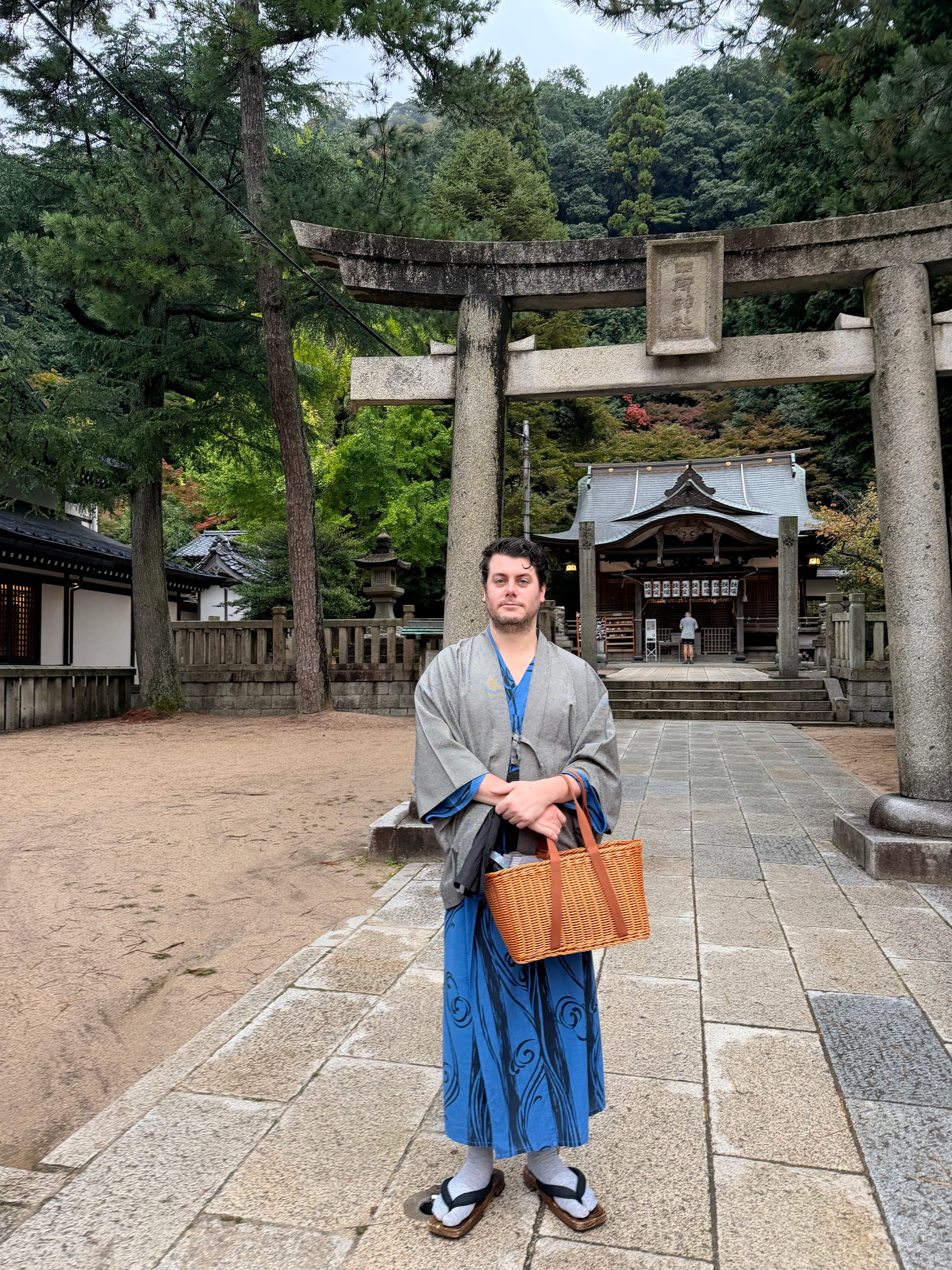
And after stuffing ourselves (our feast ended with a massive snow crab hot pot, an obscene final course to bring out when you're already 2.5 hours into an elaborate dinner), what else is there to do but strip naked in front of a bunch of men, stomach bloated with enough snow crab to feed a pod of orcas, and sink into more scalding hot water? I once again felt like an ancient Roman or Japanese noble, with my evening of soaking in public baths and my dinner of exotic luxuries, and I wondered why our richest citizens spend all their time desperate for attention on Twitter and starving themselves, when they could be living like this instead?
A toilet at the mall — in Kyoto
Nearly 20 years ago, on my first trip to Japan, I fell in love with Kyoto, and ended up spending 10 days there, exploring temples day after day, and getting lost in such a beautiful and peaceful city. Since Justin had never seen it before, I knew we had to at least stop by, despite hearing the horror stories of how it's become a tourist bonanza in the decades since. And boy are those stories correct!
I couldn't believe the hordes of tourists, choking the sidewalks so badly the only option is to walk through traffic if you want to get anywhere, and how difficult it has become to find a decent spot for dinner that doesn't have a 2-hour wait, or wasn't booked out 3 months ago. It depressed me, if I'm being honest, to see a city that was so formative to me when I was younger, turned into a place that felt, at times, like you weren't actually in a 1,200-year-old city, but were in some sort of Japanland inside Disney World.
There was a Kyoto before Instagram, and there's a Kyoto after. It's not like there weren't tourists 20 years ago — I remember finding them unbearable at the Golden Pavilion in particular, and shudder to think what that temple is like now — but the sheer number of tourists (in 2024 over 10 million foreigners visited Kyoto, on top of 45 million Japanese visitors!) is beyond staggering. Sure, there are still places you can find that haven't been mobbed, but practically every corner felt as if it had been touched, in some way, by the volume of tourism.
The entire city felt like an ecosystem in which an invasive predatory species had moved in, and the locals had developed different evolutionary strategies to survive. Some bars and restaurants leaned into tourism, making a pretty penny in high-trafficked areas with their English menus and middling food. Others had developed ways to discourage tourists, like refusing to have an English menu (and many, I noticed, with only hand-written Japanese menus, presumably to make it more difficult for Google Translate to read them), requiring a cover charge to enter, or simply maintaining a vibe designed to scare off most tourists. Many of the best spots we found kept the majority of tourists away by not having seats, forcing you to stand the whole time, and by not serving traditional Japanese food ("No sushi," a waitress greeted us with at one restaurant, which confused us until we witnessed the endless parade of tourists who entered, saw a chef standing behind a counter, and asked, "Sushi?").
The city has become so overstuffed that it even threatens one of my favorite parts of Japan: the easy availability of high-quality public toilets. As someone with a — let's call it — Jewish stomach, one that likes to act up when I'm traveling, I never feel more comfortable than when I'm in Japan, where I know even a dive bar will have a private bathroom with a gorgeous bidet waiting for me in case of an emergency. But in tourist-ravaged Kyoto, the bars and restaurants were too packed to even get into, leaving me feeling sheer panic when crisis suddenly hit.
Thankfully I had already done the dirty work 20 years ago, and I still remembered a safe space I used frequently when I was younger: the bathrooms at the Takashimaya Department Store, a massive mall right in the heart of tourist Kyoto. This store's bathrooms are the platonic ideal of public restrooms: floor-to-ceiling stall doors, high-quality bidets, well-stocked toilet paper, sparkling clean seats and floors, and, most importantly, each of the 7 floors has two bathrooms per floor, with 2-3 stalls in each bathroom, so there's no need for anyone to wait outside your stall, anxiously tapping their toes or yanking at the door like a gorilla in heat. If a stall is locked, you simply walk over to the next bathroom, where surely one will be available. I'm telling you, you've never seen public restrooms like these.
20 years ago, this store became my favorite place in the entire world to poop, and I'm pleased to report that at least one place in Kyoto has remained perfectly untouched all these years later.
Sake tasting and a tarot reading — at Toaru sake bar, in Kanazawa
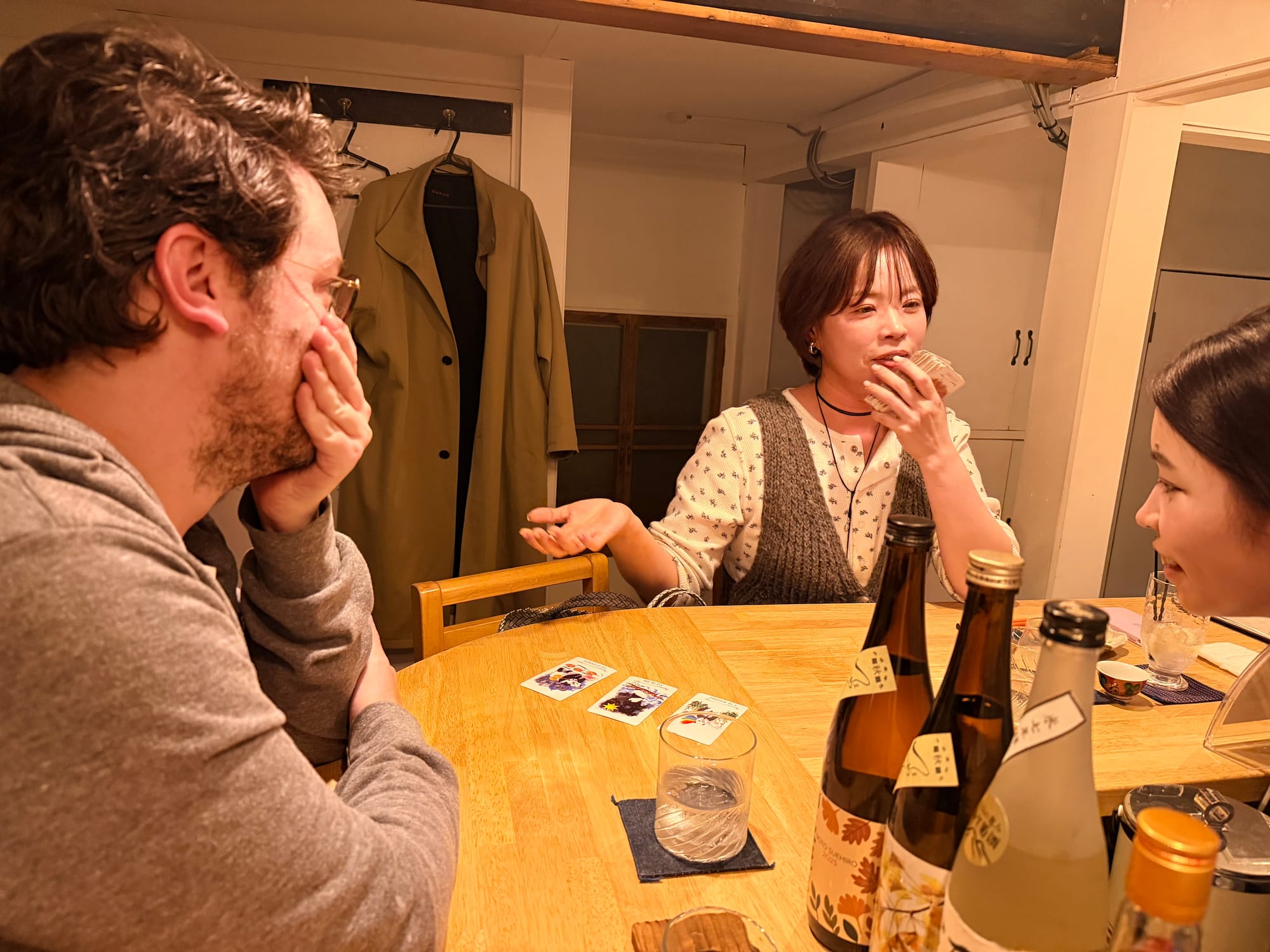
We stumbled upon a teeny-tiny little sake bar tucked in the historic old town of Kanazawa, where we planned on only having a single drink before dinner, but unexpectedly had our favorite bar experience of the trip. Inside a space the size of my apartment's bathroom sat only one woman at the bar, with another woman standing behind it, pouring from a bottle of sake. We sat down, the bartender poured us some glasses of sake to taste, and we didn't leave for the next 3 hours.
Over that time we got to know the bartender Chori and her patron Maki, who were both happy to practice English with us, while peppering us with questions about New York, and swapping travel stories (Chori in particular has been everywhere, as I later saw when we connected on Instagram; in comparison to her, I've practically not left my house). "How long have you two known each other?" I asked, delighted at being allowed to crash these two Kanazawa besties' cute little sake night, and they laughed. "We met tonight!"
Maki, it turns out, is a nail artist and tarot reader, and next thing I knew she pulled out her tarot deck and asked, "May I?" Maki proceeded to give Justin and I each a tarot reading, and while I won't say what she told us, I will say that she really nailed each of us. It was an impressive display, only the second tarot reading I've ever had, and I'm now no longer a skeptic and will in fact be devoting my life to tarot moving forward (I was also, it should probably be noted, on my fourth glass of sake on an empty stomach).
Our little group was soon joined by two more women, both also locals from Kanazawa: one was an English translator, and the other woman knew a fair amount of Spanish. What resulted was an extremely fun conversation — just Justin and I and these outrageously charming women — in which we all communicated and translated for each other in a mixture of Japanese, English, and Spanish. The woman who spoke mostly Japanese and Spanish also knew a little bit of at least 5 other languages, but mostly just phrases like, "Stop staring at me," in Russian, or "Don't touch me," in German. "I know how to deal with creepy guys anywhere," she told us, and we all laughed as she taught the other women all the different ways you can tell a man to leave you the fuck alone.
Once our rumbling stomachs got too loud, we sadly had to part ways and head out in search of dinner, but not before following each other on Instagram, and drunkenly insisting that we simply had to have been friends in a past life, because this was too good a connection to be random. It's rare to make real, potentially lasting friends while traveling in a foreign country, but don't be surprised when Maki or Chori pop up again in a future email, visiting us in New York. It was written in the cards!
Unbelievable music — at JBS (Jazz, Blues & Soul), in Shibuya
Since you've made it this far, I'm going to let you in on a secret. When you go to Tokyo, everyone will tell you to go to a bar called Little Soul Cafe (the NYTimes just wrote about it, again, for like the 10th time), for a great vinyl listening experience. And I'm not discouraging you from going there! But if you want a truly spectacular and unique experience, the lesser-known JBS (Jazz, Blues & Soul) bar in Shibuya is where you should go. (In fact, while we were there, I heard a local laughing to someone else, "I tell every visitor to go to Little Soul Cafe, and I've never even been there! I just don't want them coming here.")
You'll be discouraged, upon looking it up, by the low ratings on places like Google Maps and TripAdvisor, with endless 1-star reviews from patrons who got kicked out or treated terribly by the owner. But that is a sign of excellence, and one that should only make you hungrier to prove yourself worthy of sitting in his bar. I promise it's worth it.
The owner, Kobayashi-san, has been spinning vinyl for nearly 30 years, from his massive collection of 10,000-plus records that line the walls. His area of expertise spans everything from jazz, funk, blues, and soul, to hip-hop, R&B, and rap — and if this elderly Japanese man were to play in Brooklyn, I'm telling you he'd be the most in-demand DJ in the city. His depth of knowledge was staggering, jumping seamlessly from 70s blues to new 2025 music from artists like Lady Wray, and everything in between. With each new song, someone would get up from their seat and lean over the bar to see what record he had put on, all of us trying desperately to remember every single artist's name. Obviously this is beside the point of the experience, and music streaming is a scourge on art and culture, but, I'm sorry — I really need this guy to make some fucking Spotify playlists!
But mostly due to the bad reviews, I was worried we wouldn't be accepted. I don't think of myself as particularly cool, especially not in deeply cool Tokyo, and it sounded like Kobayashi-san refuses to serve anyone he deems unworthy. So we walked in, trying our best to straddle the line between looking cool but also normal, desperate for acceptance.
The owner was lining up his next track, so I tried to look as absolutely casual as possible while waiting for a drink — I looked at the shelves of vinyl, noting the "DO NOT TOUCH MY ALBUMS" sign, trying to shape my face into a look that projected awe, and deep respect, and love of music, and also kindheartedness for good measure. I badly needed him to judge me as worthy. But I also knew that, much like getting into Berghain, nothing makes you less cool than trying to be cool, so I tried to project what I thought of as "neutral coolness," a vibe that suggested: yes, I'd love to buy a drink from you, but also no big deal if you don't want to make one right now, and in fact I might even leave in a minute, I actually do have other places to be. Mostly, I worried I was noticeably trembling.
Finally, he took off his headphones and approached me, and I quickly stuttered out a pathetic, "Uh... two beers?" and watched, my heart in my throat, as he opened two bottles, and allowed me to purchase them from him. We were in! I scampered to our little table in the corner, and we sipped our beers and sank into the music, and the more I listened the less I had to put on a look of awe and love and respect, because those feelings came naturally — I mean, this guy was truly killing it. Listening to his music, on that sound system, in that setting, made me feel like I was truly hearing music for the first time in my life. Occasionally, I'd catch the eye of one of the 8 other people in the bar, and we'd smile at each other, sharing a look of, "Can you believe this?!"
The mood was only broken by the sudden and horrifying arrival of the smell of — well, of shit, to be frank. Within seconds, the small bar was filled with the stench of rotten eggs, or farts, but also, maybe, death? Most of the patrons started gagging, except for the locals and Kobayashi-san, who kept bobbing their heads to the music, completely unfazed by the room suddenly smelling like someone had emptied their bowels directly on the floor. Was this a test, I wondered, another way of Kobayashi-san making us prove we were worthy of listening to his music? Was this the newest innovation in the field of Japanese bars coming up with novel ways to keep tourists out? Or had a bathroom pipe burst, and were we all about to be engulfed in a tidal wave of raw sewage?
Our nostrils burned with the stench, and I worried the smell would cling to my clothes, my skin, my hair. We were flying home in the morning; would I fill the entire airplane with the smell of rotten egg farts? I kept making eye contact with a woman across the room, each of us sharing a look like, "What the fuck is going on?" but also kind of blaming each other with our eyes, like: "Did you fart?"
Thankfully I travel with Justin, queen of the self-care aisle, who whipped out a travel-sized stick of Aesop essential oil, a mixture of ginger root, lavender, and geranium, which we rubbed on our upper lips, and which replaced the stench with a lovely calming odor. Thus immune to the rank stench filling the bar — which seemed to evaporate after 30 minutes or so, with no explanation; maybe someone did fart! — we spent the rest of the night listening to the most spectacular DJ in Japan play an endless set of sublime American music. Hours after he had flipped the sign on the door from "open" to "closed," he kept spinning tracks for us, and none of us could bear to leave before he decided to be done. It was the perfect send-off, and the best way to make me promise myself that I will come back.