#71: Speaking of bloody public spectacles: the Aztecs!
Death By Consumption
9/9/25 - 9/15/25
What a weird week, huh! How are you doing with your government-enforced period of mourning? I'm genuinely shocked they haven't outlawed wearing colors for 30 days, like some sort of medieval funerary superstitious ritual. 12 hours in the stockades for Goody Miller for not wearing a black dress to the market! The National Guard marching door to door to ensure we've shrouded our mirrors and are lighting prayer candles nightly. I know better than to publicly write what I think here — where it can be scraped into some Palantir database that results in Marco Rubio putting my passport in a shredder — but let me just say that this better not be a one-time-thing; I think every podcaster's death deserves this treatment. Fly the flags at half-mast for Hawk Tuah Girl. A 21-gun salute for Call Her Daddy. Rename an airport after Nick Viall! Podcasters are our bravest soldiers, and it's time we start treating them as such.
This week was unexpectedly morbid: I watched two classic films about death, started another potentially slop scifi series, read a scathing obituary, got mad at one of the husbands from Couple's Therapy, and read two books about the end of the Aztecs.
Sorcerer (1977) — on Criterion
This is not one of those movies you put on to chill out. This was a stressful, high-tension, ass-clenching ride. I loved it! Sorcerer, directed by William Friedkin (the madman behind The French Connection and The Exorcist), follows four men living in a remote jungle outpost in Central America, all of whom have left society behind, due to some sort of criminal past. To make money, they’re assigned the extremely dangerous job of transporting 2 trucks’ worth of explosives through the jungle — but the dynamite is old and leaking, so the trucks will explode if they so much as hit a bump wrong. It’s a great, simple premise for a high-stakes plot, one that takes the nightmare of, say, trying to drive a Uhaul through Manhattan at 5pm, and ups the stakes with explosives and rickety jungle bridges.
And that bridge sequence: holy shit! The centerpiece of the film is a scene in which both trucks have to cross an old wooden suspension bridge over a raging river, while the bridge more or less collapses beneath the trucks. It’s a tense, beautifully shot scene (practical effects — bring them back!) that is one of the most incredible things I’ve seen in all of 70s cinema (supposedly the scene alone cost $3 million and was extremely complicated to film, with the trucks occasionally actually falling into the river). Even crazier, the actors were the actual drivers in the film, with star Roy Scheider calling it the most dangerous scene he’s ever filmed. I know you could never do something like this anymore due to union rules or whatever, but you can't argue with the results: sometimes, abusing your actors results in some fantastic cinema.
The film is bleak, hopeless, tense, and ultimately a depressing meditation on the fact that death comes for us all, one way or another. It’s a really fun watch!
Gosford Park (2001) — on Criterion
Gosford Park has been one of those movies that I’ve wanted to watch for, like, 20 years, but could never quite pull the trigger on all 2.5 hours of it. But, sidelined for most of the weekend with a cold, I felt the time was finally right. When was the last time you watched Gosford Park? You should watch it! It's a surprisingly good time.
The cast is stunning — every few seconds, for the first 15-20 minutes, you’re like, “Him? Her!” — even though I couldn’t tell half the characters apart. There are, say, 7-10 characters whose whole storylines I still have zero clue about. Why were there, like, 4 women who looked exactly the same, all with similar-looking blonde husbands? Is this a commentary on the indistinguishability of the upper classes, or is that just what all British people look like?
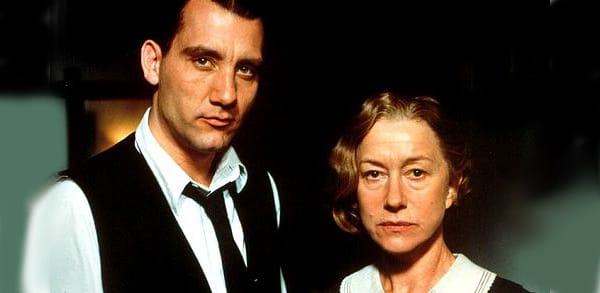
But whatever, you don't need to even follow all the 25 storylines; this movie is simply a series of impeccable vibes smuggled into a murder mystery, and the whole point is just to sit back and enjoy all the upstairs-downstairs gossip and scandal. “I could watch this for 8 hours,” I said to Justin, apparently having forgotten completely about the existence of Downton Abbey (I watched the first season when it aired and then gave up, so maybe 8 hours is my actual limit for this sort of thing). The only real complaint I have about the film is that Ryan Phillippe is bisexually seducing nearly everyone in the manor, but not Clive Owen? What a waste!
Foundation, episodes 1-2 — on Apple TV+
Sometimes I have to let Justin drive the remote control, for fear of inciting a full-blown in-home rebellion against my tyrannical TV rule. And after we completed Silo (flop of a second season… could have been an email!), he wanted to watch another Apple TV+ scifi thing, so Foundation it is. So far, I'm... wary. It's impressive, I will say, that Apple has invested so much money in such a complicated, hard-scifi show. Adapting Isaac Asimov's Foundation trilogy really feels like a fool's errand, so the fact that the story is even somewhat coherent is a genuine feat.
Tragically, all that effort is undone by casting some truly horrible actors in the lead roles. Lee Pace and Jared Harris are fantastic and able to carry even the most complicated scenes quite easily, but the main actress and the guy who plays her love interest are CW-quality actors at best, and I'm finding it unbearably distracting. I know the series is going to jump forward into the future at some point, and I'm hoping that means they'll swap out for some better actors. Even tens of thousands of years into the future, I guess, humanity will still be producing some awful actors.
"The Rational Outcome" by Tom Scocca and Joe MacLeod — in The Indignity
Much has been written about the death of Ch*rlie K*rk, but this day-of post said mostly everything that needed to be said about it. "This country seems inflammable right now, in large part because there is a well-funded industry dedicated to keeping it inflamed," in particular, pretty much gets to the heart of the matter. I hope you're living the kind of life that doesn't result in obituaries like this written about you!
"My wife and I had couples therapy on TV. It nearly wrecked our marriage" by Boris Fishman — in The Guardian
I know we have more dramatic issues right now, but this essay from Boris, one half of one of the couples on the latest season of Couples Therapy, is the perfect outrage bait. In it, Boris writes about his experiences filming the show, the issues it caused in his marriage, and tries to give us his side of the story. Reading it got me all riled up again at Boris — one of the most self-righteous and obnoxious people on his season — but also made me feel a little bad for him. Not just for how he was treated by the internet (agreeing to let millions of people watch you and your wife do therapy does not seem like an easy process), but for the fact that whatever editor commissioned this piece absolutely set Boris up for even more public floggings.
Boris's issues, while specific to his experiences, are all the same things we've heard from 30+ years of former reality stars: the editing was unfair, there's more you didn't see, people are being mean to me on Reddit. While these complaints are trite and tired, I'm still sympathetic to them — going on reality TV in 2025 seems like it invites nothing but horrors into your life, unless you can miraculously float above it all, like Parvati. But once Boris starts telling us "his side" (most of which, he claims, never made it into the show — even though every single thing he tells us did make it into the show) it's clear that he still doesn't get it.
You see, the main issue with Boris and Jessica is that he hates living in New York — due to some still-vague connection to the fact that it's where his family immigrated to from the Soviet Republic — but she loves it. In search of stable employment and a home anywhere but New York, Boris dragged Jessica and their kids around the country for years; he estimates that his daughter had slept in 10 different beds before the age of 3. The whole time, Jessica is only growing more miserable. So, in an attempt to save his marriage, Boris agrees to move back to the city, a place he hates, where Jessica becomes happy, and Boris becomes miserable.
Except: turns out they didn't move back to the city! They bought a house, in “rural New Jersey.” Now, don’t come for me, Jersey folks, but that is not moving back to New York, no matter how close to the PATH you live. Boris and Jessica and the kids aren’t crammed into a 2-bedroom apartment, they’re not hearing screaming or sirens outside their windows at 3am, they’re not juggling groceries and strollers on the M train while some Bushwick gay in a K-hole nods out on their shoulder. They own a house in a rural area!
So basically, Boris's complaints have nothing to do with living in the city, because he doesn't live in the city. He's simply furious to be geographically near New York at all — and it’s all Jessica’s fault, naturally. His other complaints are small-bore: he had to file their taxes, fix problems around the house (or, as he points out, hire other people to fix problems), figure out health insurance. Meanwhile, what does Jessica have going on? “She was struggling with her own difficulties: recovering from pregnancies, trying to advance in the first years of a career that had yet to pay well, often taking the lead on the kids. She was also very tired from our endless fighting.” Oh, just recovering from pregnancies, trying to advance in her career, and taking the lead on childcare! But Boris had to clean out the gutters, so, really, who had it worse?
This entire essay is, in fact, enraging the more you read. Like, this paragraph is a gorgeous, spectacular display of an absolute unwillingness to look at Boris's own fault in the relationship:
I would offer that this problem existed in part because of me – I wanted to price-check more plumbers than she did. I was ready to build a bridge of compromise if she had ideas on how. She didn’t. So I offered some of my own. But this back-and-forth required more energy and creativity than she had, or wanted to put forward, and so she just promised she’d help more. But she rarely did. On it went this way, until I became apoplectic with resentment. And then she did, too. But only I shouted. She retreated into herself. On a screen, unlike in life, only one of these behaviours feels toxic.
See how he starts with "it's my fault" before pivoting to "but let's focus on how it's her fault?" Now that's some toxicity! And, in fact, I would argue that shouting and retreating are — as he argues in that paragraph — not equally toxic. That’s not how toxicity works! Sure, retreating constantly and not advocating for herself is going to have long-term toxic effects on a relationship, but to equivocate those two is asinine. Beyond that, the sheer lack of self-reflection is staggering — still, after all this time and public exposure! Boris refuses to recognize that if you’re shouting at your partner, and they’re retreating, maybe you should stop shouting at them.
I have no idea why this article was published, so many months after the show aired, but I'm glad it was. I needed something trivial to get upset about! It also, unfortunately for Boris, proves the opposite point he's trying to make, and only makes me love Couples Therapy more, for letting me obsessively judge and weigh in on random couples' drama and personalities. When I watch Couples Therapy, I'm basically a mini Dr. Orna, raising an eyebrow on my couch, murmuring to myself, diagnosing everyone with disorders that probably aren't even in the DSM. In fact, this article only made me wish this were a regular, weekly feature — let the participants blog every week, telling us their side of that week's therapy session. It could serve as a regular pressure valve for all of us, a safe place to focus all our frustrations.
Reality TV is born on the backs of the least self-aware people accidentally exposing their deepest insecurities to a judging public, and Boris is simply the latest piece of red meat for us to tear apart. He's basically Huda from Love Island, but with a graduate degree. The reality TV machine thanks you, Boris, for agreeing to be crushed between its merciless gears for our entertainment. Thank you for your service. 🫡
The Fifth Sun: A New History of the Aztecs, by Camilla Townsend (2019) — paperback
This history of the Aztecs is seemingly the first major work to rely primarily on the words of the Aztecs themselves, rather than the Spaniards who conquered them. Relying on the written records of 15th and 16th century Mexican friars — most of whom were the grandchildren of pre-conquered Aztecs, who used their newfound ability to read and write to record the stories told to them by their grandparents — it's a genuinely mind-blowing piece of history that lets you hear (for the first time, in my case) what the North American natives were thinking, saying, and feeling during the pre-colonial and colonial periods.
While the story is, ultimately of course, tragic, it's not all doom-and-gloom; Townsend finds surprising moments of levity (which is actually kind of easy, since Hernán Cortés was, by all accounts other than his own, a fucking idiot). Like this scene, in which the Aztecs remember a time when the Spaniards attempted to intimidate them by building a catapult, but they were too stupid to make one that actually worked:
And then those Spaniards installed a wooden sling on top of an altar platform with which to hurl stones at the people.... They wound it up, then the arm of the wooden sling rose up. But the stone did not land on the people, but fell [almost straight down] behind the marketplace at Xomolco. Because of that the Spaniards argued among themselves. They looked as if they were jabbing their fingers in one another's faces, chattering a great deal. And [meanwhile) the catapult kept bobbing back and forth, going one way and then the other.
It's important, as a white person, to know that people of color have been laughing at our stupidity for literally hundreds of years.
There are endless fascinating moments like this in the book, which is short but packed with details that bring a nearly lost civilization practically back to life. It's also simply a beautifully written, lovingly told story, one that doesn't treat the Spaniards unfairly for the sake of it, but rather seeks to correct the record, and to try to peer through the centuries of propaganda and myth-making. I especially loved her analysis of why so many people believed (and continued to believe) that Cortés was seen by the locals as a god upon his arrival, which she explains succinctly and convincingly as:
In retrospect, the story of Cortés being mistaken for a god seems so obviously self-serving and even predictable that one has to wonder why it was believed for so long. In a fascinating turn of events, by the 1560s and ‘70s, some of the Indians themselves were beginning to offer up the story as fact. … The young indigenous writers were from elite families, the same ones who, forty or fifty years earlier had lost everything with the arrival of the Spaniards. And they were longing for an explanation. How had their once all-powerful fathers and grandfathers sunk so low?
And, frankly, if a bunch of merciless killers showed up on your shores, bearing the miraculous horrors of horses and gunpowder, and everywhere they went people dropped dead from a mysterious illness, wouldn't it be easier to write it all off as the act of a god? Or, at the very least, the acts of someone who could quite easily be mistaken as a god? Who could blame them?
You Dreamed of Empires, by Álvaro Enrigue (2024) — paperback
I kept the Aztec train a-rolling with this slim novel, which imagines the moments after the Spaniards arrived in Tenochtitlan (Mexico City), and were anticipating the first official meeting between Cortés and Moctezuma. For such a monumental period in history, the book is languid and drifting, dreamlike and hallucinatory. Enrigue's Moctezuma is the fearsome ruler of a bloody empire that regularly sacrifices humans and possibly even eats their flesh, but he's also a depressed, aging man who has a bit of a drug problem:
The afternoon of November 8, 1519, Moctezuma did exactly what he always did after eating, even if the whole world might change forever from the moment he woke up. He lapped the paste of magic mushrooms and honey from the Oaxacan black-clay spoon handed to him by the serving girl, and sat in the sun until he felt his eyes closing. Amid a now absolute silence he walked to his room and his bed. He took off his cape, his mantle, and his breechcloth, and got under the goose-feather coverlet. He pulled it up to his eyebrows and fell asleep.
The book focuses less on the world-shifting events at play, or the blood and sacrifice and violence you'd expect from an Aztec novel, but more on the feelings, tension, and even comedy of two civilizations coming face-to-face for the first time. The Spaniards are dumb and scared, and spend the majority of their time getting lost in the maze-like passages of the palace, scurrying around "like little dogs." Their feelings alternate between a very believable mix of false bravado, extreme paranoia, and a general sense of "why the fuck are we here?"
Everyone, whether they're on mushrooms (and there are a lot of mushrooms) or not, feels like they're caught in a dream, or a nightmare. The book is full of tension and paranoia; it feels like the slow, ponderous night before you wait for your execution in the morning. The end is simultaneously sad and triumphant, both a conclusion and a new beginning, and finally brings the blood and violence that has been lurking in the corners the whole time. "Inside each of us is a skull, and that’s all that will be left of us when we’re gone; thanks for your participation."